
The AI-Powered Flipped Classroom: Turning Homework into Deep Learning
As an educator, I have always loved the idea of a flipped classroom.
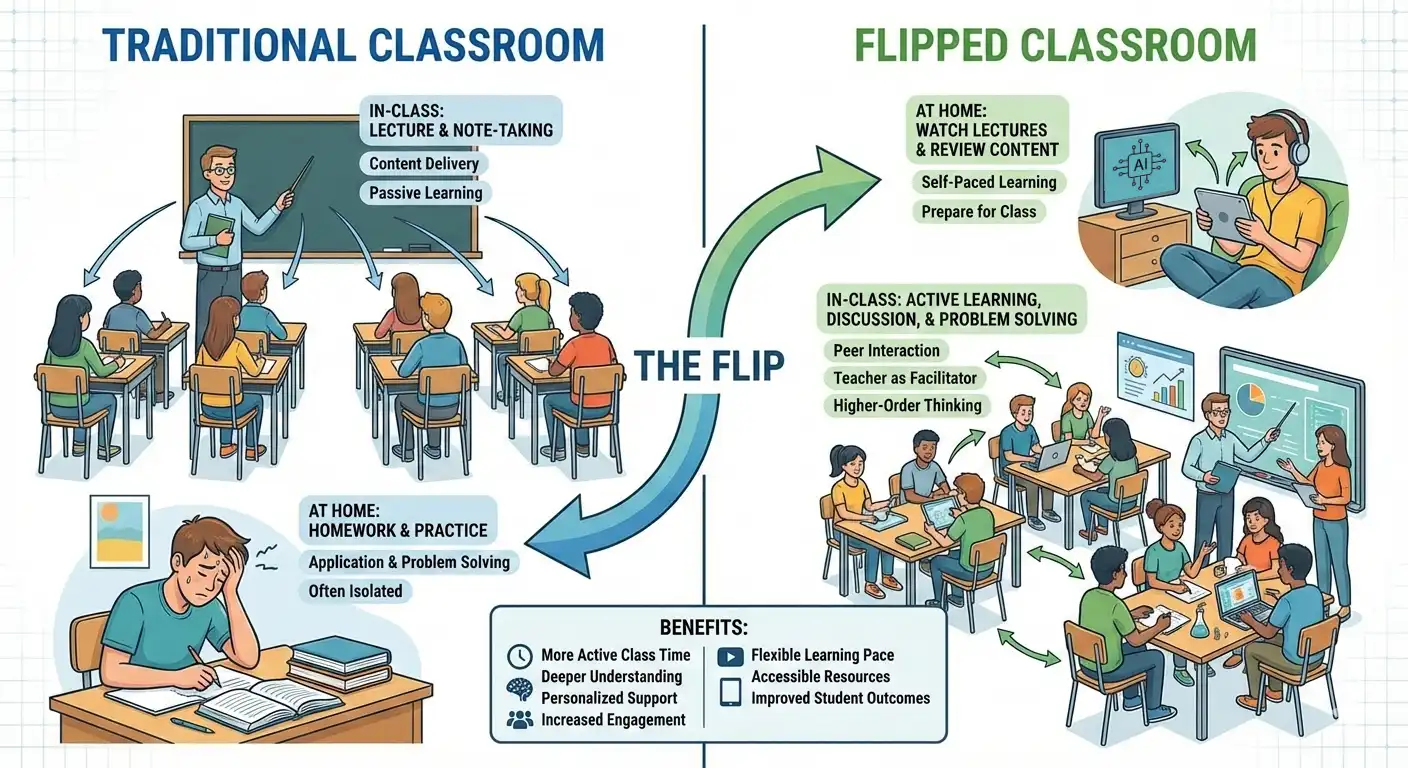
The idea is simple: students gather foundational knowledge at home (via videos or readings), leaving precious class time for active discussion, problem-solving, and deep dives. But in reality? The execution was often exhausting.
Creating high-quality pre-class materials took hours. Ensuring students actually did the work was a constant battle. And if a student got stuck at home, they stayed stuck until the next day.
If you are an educator who has faced these same frustrations, AI is the missing piece of the puzzle.
Artificial Intelligence has handed us the keys to finally unlock the true potential of the flipped classroom without burning out the teacher. It’s no longer about us creating hours of video content; it’s about empowering students to become active researchers at home.
Here is how we can implement a truly effective, modern flipped classroom using AI.
Redefining Homework (The Mindset Shift)
The biggest fear teachers have regarding AI is students using it to simply "finish" their homework. But what if the homework itself is about researching with AI?
To flip the classroom effectively, we have to flip the type of assignments we give. As homework, teachers should define specific research topics and set clear expectations for the inquiry process. This encourages students to use AI as a thinking partner rather than an answer-dispensing machine.
An effective way to make this possible is to encourage students to use Socratic AI (read more about socratic AI here ) rather than generic chatbots. While tools like ChatGPT’s "Study Mode," Gemini’s learning features, or KhanMigo are popular, the goal remains the same: guidance over instant answers.
At inAI, we provide a dedicated Socratic AI tool that can be customized by schools. This allows educators to design the specific type of guidance and guardrails their students receive, ensuring the AI acts as a tutor, not a shortcut.
The Essential "Reality Check" Briefing
Before students start their research, they must be educated on one vital fact: AI can make errors. If students go home believing that every AI response is "absolute gospel," the flipped classroom discussion the next day will be built on a foundation of misinformation. They need to know right out of the gate that these tools, while incredible, are prone to "hallucinations" and confident mistakes. (read more about AI hallucinations here )
Teach them the golden rule: Trust, but verify. Make it a requirement to cross-reference a bold claim made by the AI with a traditional source, like a textbook or a reputable website. This doesn’t just mitigate errors; it builds 21st-century critical thinking.
The New Workflow: What it Looks Like in Practice
Once the ground rules are set, here is how the AI-powered flipped workflow functions:
Phase 1: At Home (The Investigation)
Instead of "Read Chapter 4," the assignment is an inquiry mission:
- The Task: "Use an AI tool to explore the concept of Photosynthesis. Investigate the chemical equation and the role of sunlight."
- The Deliverable: Along with the learning, students also bring in their chat logs or a list of prompts they used.
- The Verification: They must note at least one piece of information they verified using another source.
Phase 2: In Class (The Human Connection)
Since students already have the basics, you don't need to spend 45 minutes lecturing. Now, you facilitate:
- Critical Discussion: Ask students to explain their findings to each other. This enables peer transfer of knowledge and allows you to spot and address common misconceptions.
- The "Stuck" Support: If some students found the research difficult, use this time to suggest new keywords or alternative ways of searching.
- Prompt Critique: Review the prompts used. Why did one prompt get a better explanation than the other? This builds AI Literacy.
- Error Hunting: Compare answers across the class. If the AI gave different students contradictory information, lead a discussion on how to determine which source is correct.
The Teacher's Role Transformed
In the AI-powered flipped classroom, the teacher is no longer the "sage on the stage" delivering content. You become the expert facilitator, the lead fact-checker, and the guide to critical thinking.
You are helping students navigate the messy, complex world of information synthesis—a skill far more valuable than memorizing facts. Flipping the classroom used to be hard work for the teacher; with AI, the hard work is shifted back to the student's thinking process, exactly where it belongs.