
The Three Pillars of an Effective AI Program in Schools
With CBSE mandating AI education from 2026, many schools are already working towards putting a meaningful AI program in place. While this can feel like a daunting task, it is far from impossible. What usually makes the difference is not scale or sophistication, but how thoughtfully a few core elements are handled.
An effective AI program does not require perfection. It requires clarity.
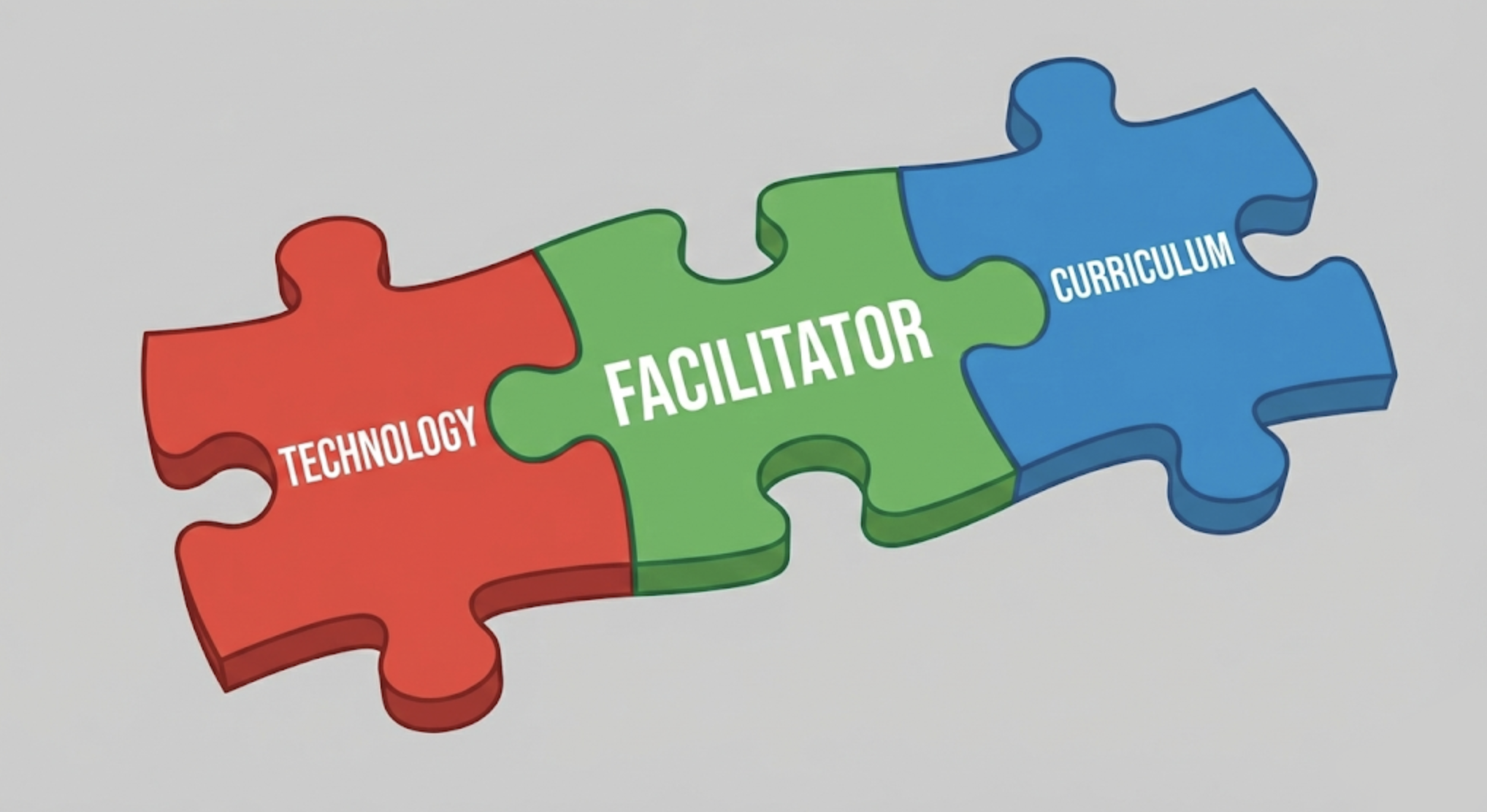
At its foundation, every successful AI program in schools rests on three interdependent pillars: curriculum, technology, and the facilitator. When these three are aligned, AI education moves beyond tool usage and becomes genuine learning.
Curriculum: the foundation that holds everything together
The backbone of any AI program is its curriculum. Without a well-thought-out structure, even the best tools fail to create lasting learning. A strong AI curriculum should be comprehensive, ethically grounded, and designed to build critical thinking rather than replace it.
One advantage schools currently have is direction. CBSE is in the process of releasing AI curriculum guidelines mapped from Grades 3 to 12, offering clarity on the competencies students should develop at different stages. In addition, organisations such as UNESCO and initiatives like SOAR provide broader frameworks that help schools think about AI education beyond technical skills.
However, following guidelines alone is not enough. For AI education to truly work, the curriculum must be contextualised. Students should be able to see AI reflected in their own environment, culture, and daily experiences. When learning feels connected to real life, students engage more deeply and retain concepts better.
(We’ve explored this idea further in our blog on essential elements of an effective AI curriculum.)
Technology: enabling learning, not overwhelming it
AI is often seen as the peak of modern technology, but in schools, technology should act as an enabler—not a barrier. An effective AI program requires just enough technology to support learning without making it overly complex.
This includes devices, connectivity, and the software tools students interact with. Many schools already have an ICT lab, which provides a strong starting point. Adding tools like an interactive board or a projector can significantly improve classroom discussions, allowing facilitators to demonstrate concepts, analyse AI outputs collectively, and guide reflective conversations.
ICT labs also play an important role in enabling individual exploration. AI learning becomes meaningful when students are given the space to try things on their own, observe outcomes, and ask questions.
Connectivity, however, remains a challenge. Since most AI tools rely on cloud-based models, a stable internet connection is often assumed. In reality, many schools—especially in semi-urban and rural areas—face limitations due to security policies or infrastructure constraints. In such cases, opting for platforms that support offline or low-internet usage becomes essential. This not only makes implementation practical but also enhances safety for students.
Facilitator: the most irreplaceable pillar
There has long been a question around whether AI can replace teachers. History suggests otherwise. Teachers have adapted through every technological shift—from textbooks and radio to the internet—and AI will be no different.
In fact, AI education makes the role of the teacher even more critical. Facilitators help students question AI outputs, understand limitations, and apply judgement—things machines cannot do on their own.
The real challenge lies in preparing teachers for this role. Today, many students are exposed to AI tools earlier and more frequently than their teachers, which makes teacher empowerment an urgent priority. At the same time, schools must be mindful of teacher burnout. With educators already juggling multiple subjects, administrative responsibilities, and documentation work, any AI program must strike a careful balance—supporting teachers without adding to their burden.
Bringing the pillars together
Managing curriculum, technology, and facilitator readiness together can feel overwhelming for schools. But when these three pillars are addressed in alignment, AI education becomes far more manageable and effective.
At inAI, the focus has been on supporting schools across all three areas—through structured and contextual curriculum design, practical technology choices, and facilitator support—so that AI literacy can be introduced without disrupting existing systems. The intent is not to add another layer of complexity, but to help schools build AI education that fits naturally into their classrooms.
As AI becomes a formal part of school education in India, the real measure of success will not be how advanced the tools are, but how thoughtfully learning is designed around them.